Stop re-enrolling users at every new build. Learn how a multi-site data center access control system centralizes biometric identity across facilities.
What you’ll learn: The benefits of centralizing biometric identity across data center sites. You’ll see how it’s possible to enroll your users once and manage their identities and access consistently across every location, without starting over at every new build.
Who should read this: Facilities and physical security directors, along with IT/security engineers at colocation providers, hyperscalers, and enterprises with multi-site data center portfolios. You already understand the value of biometric access control, but you’re concerned about the workload of managing biometric identities across a growing data center footprint.
It’s easy to find headlines around the data center construction boom right now. What’s not getting air time are the challenges with securely managing physical access control for data centers across multiple sites. The concerns kick in well before a new data center facility officially opens for business.
- Hundreds of electricians and other tradespeople, including fire, mechanical, and technical crews, are flowing in and out of the construction site for months on end. Many need access to multiple facilities within a data center company’s portfolio.
- Relying on a key card reader at the entrance of a new build can create access bottlenecks that are a drag on productivity and frustrate users.
- These problems don’t go away once a facility becomes operational. Technicians, tenants, staff, and visitors all need quick identity verification to access the spaces they need to do their jobs.
Many teams already use biometric authentication to verify that the person requesting access matches the enrolled identity. At a busy construction entrance, this can help large crews move through faster while giving data center security teams confidence in who is entering. But if each facility runs its own biometric system, every new site creates another enrollment process and set of identity records to manage.
Data center security and operations leaders don’t want to start over with every new build. They need centralized biometric identity management that works alongside the access control system already in place to scale smoothly to every new facility.
Why Does Biometric Access Get Harder To Manage As You Add More Data Centers?
As facilities open and people move between them, it’s a challenge to keep enrollment and identity records consistent:
- Users often must re-enroll at each facility, increasing administrative load.
- Using different biometric vendors, readers, and processes at each facility creates fragmented records.
- Facilities that require multi-factor authentication often must install separate readers for each modality at entrances. This doubles the hardware, wiring, and maintenance requirements across every entrance at every site.
- Some users require access to more than one facility, and teams lack a single view of where they’re enrolled. There’s no easy way to show auditors which users have biometric access across all facilities.
- Colocation security is challenging, as many tenants and escorted visitors require consistent cage-level access.
- Offboarding a user requires removing their access across multiple sites.
The pains of fragmented management get worse with every new facility build. Combating the problem requires a system that centralizes biometric access control.
What Is A Multi-Site Data Center Access Control System?
A multi-site data center access control system coordinates physical access across multiple facilities through a centralized management platform. In a biometric deployment, centralized identity management lets people enroll once and have their biometric data synchronized to readers at the sites where they’re authorized. The physical access control system (PACS) continues to determine which doors each person can access.
The chart below compares managing biometrics separately at each facility with a centralized management model.
Site-by-site vs. centrally managing biometric identity
|
Biometrics managed separately at each facility |
Centrally managed biometric identity |
|
|
Enrollment |
Users re-enroll at every site |
Users enroll once and can automatically authenticate at any site where they’re authorized |
|
Adding a new site |
Setup and enrollment start from scratch |
The new site connects into the existing deployment |
|
Users |
Tracked separately at each facility |
One identity across all facilities |
|
Offboarding |
Access is removed site by site |
Access is managed from one place |
|
Records and audits |
Pulled separately from each site |
One view of who entered, where, and when – across all sites |
|
Technology vendors |
Different readers and processes exist at every site |
One platform standardizes operations across every site |
One reader can support multiple credentials
A multi-modal reader can handle biometric and key card authentication at the same door, eliminating the need to have a separate reader for each. For example, the Arc Suite of biometric readers authenticates a combination of face, fingerprint, card, and PIN through a single piece of hardware. The credentials supported depend on the reader model.
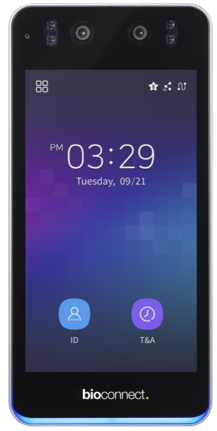
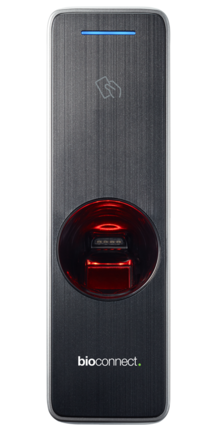
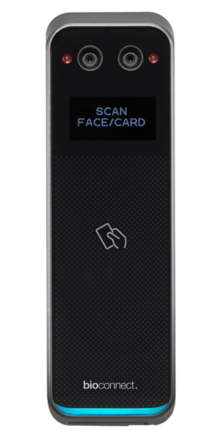
|
Face + Card + Pin Authentication in one reader |
Card + Fingerprint Authentication in one reader |
Face + Card Authentication in one reader |
|
Ideal for higher-security doors needing extra authentication factors. |
Ideal for deliberate, high-assurance authentication. |
Ideal for high-throughput entrances. |
Every Arc reader is also managed through a single platform and rated IP-67 for dust and water ingress, making them a good fit for data centers under construction.
How can biometrics speed up access while a data center is under construction?
Biometric authentication can help construction crews move through busy gates faster by verifying identity in seconds. Centralized identity management lets them continue using that enrollment when the facility enters operations and at other sites where they’re authorized.
For example, an Arc Rex reader installed at the outdoor gates will support high throughput for the many tradespeople and mechanical crews requiring access. If the construction site requires MFA, crews can authenticate with a key card and their face on the same reader.
What Makes Centralized Biometric Identity Management Possible
The architecture that simplifies biometric identity in multi-site deployments is a MAS/SAS (Master Application Server/Satellite Application Server). An example of a system that uses this architecture is BioConnect Enterprise.
- MAS is the system’s central node. It manages the PACS integration, along with identity and credential information.
- Once a user enrolls, the MAS synchronizes their biometric data to the SAS units and readers at other sites where they’re authorized.
- If the main server goes offline, each site's server keeps that location running. Readers match from their own local memory, so doors keep working, then re-sync automatically when the connection returns.
-
Biometric data stays within your environment, encrypted in transit and at rest. Fingerprint captures become templates, while face deployments store the enrolled image and each reader generates its own template. With Consent Tracking enabled, organizations get opt-in consent before enrolling a user, and the system deletes that user’s biometric data on request or when they leave.
-
The MAS/SAS architecture allows deployments to expand to thousands of readers across multiple sites, while preserving central management. BioConnect Enterprise 5.6 supports 1,000 devices per server, meaning a multi-site deployment with 3,000 readers can run on three servers and be managed through one platform.
Dig deeper into how central management works and why it matters.
Case Study: Centralizing Biometric Identity Across a Colocation Portfolio
A colocation provider operating about 70 facilities across 25 metro areas had approximately 1,600 biometric readers. Each market used a standalone biometric instance, which meant users had to re-enroll when they needed access in another market. This created duplicate biometric records and increased administrative work, while also contributing to longer lobby wait times.
The solution: The provider brought biometric identity under a centrally managed deployment. Users could now enroll once and have their biometric data synchronized to the appropriate facilities.The results: The team was able to securely scale biometrics across markets, while cutting down on admin time and improving user experience. They also simplified user enrollment and gained better visibility and reporting across the entire deployment.
Expanding Biometrics Across Sites Can Require Expert Support
Rolling out biometric identity management across multiple facilities takes planning beyond the first installation. Engaging professional services can help guide the deployment, while technical support keeps the system running as new sites come online.
- Professional services can include hardware advice, enrollment strategy, project management, deployment and integration planning, onboarding and training, and planning for site expansion.
- Technical support can include live and online support, system health checks, annual upgrades, solution optimization, and custom technical services.
Easily Scale Biometric Identity to Every Facility
U.S. data center construction spending passed a $50 billion annualized rate in April 2026 for the first time. As operators expand, biometric identity needs to carry from construction through site operations and into future builds.
Bringing biometrics in during construction can eliminate the pain of trades crowding a single card reader to gain building access. It also establishes identities before the facility opens. Centralizing management alongside the access control systems already in place lets users enroll once and gives teams a consistent way to manage biometric identities across every facility.
Need help evaluating biometric access control for data centers? Download the Data Center Physical Security Checklist.
Want to speak with an expert in physical security infrastructure and biometric identity management? Get in touch with our team.
FAQs
Do I need to re-enroll users at every new data center site I build?
No. With centralized biometric identity management, people enroll once and their biometric datatemplates synchronizes to readers at the sites where they’re authorized. The PACS continues to determine which doors they can access.
Can biometrics speed up access while a data center is under construction?
Yes. At a busy entrance, facial authentication can reduce the need to retrieve and tap a card while verifying who is entering. Establishing biometric identities during construction also lets them carry into operations and over to other authorized sites, if you have a centrally managed system.
How should colocation providers manage biometric access across sites?
Use centralized biometric identity management alongside an existing PACS. This allows tenant personnel to enroll once and automatically synchronize their biometric data to the sites and readers where they’re authorized to enter. The PACS continues to manage access permissions throughout each facility, including data halls, server rooms, and cages.
How many biometric devices can one server support?
It depends on the solution. BioConnect Enterprise 5.6 supports up to 1,000 biometric devices per server.
Will I need a separate card reader and biometric reader at each door?
Not if you choose a multi-modal reader, such as the Arc Suite. It combines card and biometric authentication in one device. Supported credentials vary by model, and users don’t have to use multiple credentials unless your access policy requires it.