What you’ll learn: What biometric enrollment is, how it works, why it’s typically the hardest part of deploying biometric access control at scale, and solutions for removing bottlenecks.
Who should read this? Security directors, IT managers, and facilities managers who already have a physical access control system (PACS) in place and are trying to better understand the enrollment realities of a biometric deployment.
Most organizations considering biometric access control aren’t starting from scratch. Their PACS already contains employee identity records, including photos in some cases, key card credentials, and access permissions. What’s missing is the biometric identity template a reader needs to authenticate each user.
Traditionally, creating this template requires every user to be present for biometric enrollment. For an organization with hundreds or thousands of users, that adds a time-consuming, resource-intensive process to a PACS that’s otherwise already set up. This naturally raises questions for teams that want to deploy biometric access control at scale:
- How long will it take to enroll a large group of users, one at a time?
- Do employees need to be re-enrolled if they need access to multiple facilities or new sites coming online?
- Will we need to manage separate systems for each location where we have biometric readers?
- How does managing biometric data change our consent and compliance obligations?
Keep reading to get answers and discover a new approach to biometric enrollment that removes the traditional barriers to scaling biometric access control.
What is Biometric Enrollment?
Biometric enrollment is the process of registering a person’s biological characteristics so a reader can recognize them in the future. A biometric enrollment system captures biometric data—such as facial features or fingerprint patterns—and converts it into a mathematical template. That template is associated with the person’s identity and access permissions. Each time the person attempts to enter a protected space, the system compares the biometric presented at the reader with the enrolled template.
Traditional Biometric Enrollment Creates Bottlenecks at Scale
Enrolling one person is relatively quick. The effort increases substantially when it’s happening across an entire workforce spanning multiple locations.
- Multi-site deployments are complex. When launching a new biometric access control solution, organizations must coordinate physical enrollment across locations, shifts, and employee groups. Enrollment requires trained staff, enrollment hardware, scheduled appointments, and quality checks at each site.
- Every new hire needs to be enrolled. Even after the initial mass enrollment, each new user creates a physical enrollment event. Unlike key cards and PINs, traditional biometric enrollment can’t be completed entirely behind the scenes before their first day of work.
- Employee turnover adds more work. Administrators must revoke access and ensure the former employee’s biometric template is deleted according to policy. The amount of admin work required depends on how well the PACS and biometric platform synchronize.
Enrollment fatigue doesn’t have to be an automatic byproduct of adding biometric access control. There are solutions that significantly reduce the time and complexity of biometric enrollment.
Remove Biometric Enrollment Friction
Skipping the physical enrollment process altogether limits operational disruption and saves significant time. BioConnect offers a No Enrollment feature that allows administrators to sync existing profile images from a PACS or HR system when setting up facial biometrics.
- Deployment is quick. Administrators can make every user ready for facial authentication across locations without the heavy lift of in-person, manual enrollment.
- Onboarding is seamless. Existing employees and new hires get immediate access to all the spaces they’re authorized to be in.
- Compliance is top of mind. Automated enrollment takes human error out of the equation, for smoother compliance with regulatory standards like SOC 2, GDPR, and HIPAA.
Once all users are automatically enrolled, ease of ongoing management is critical. Users need reliable physical access to spaces without encountering hassles or lags. Security, IT, and facilities leaders need to be certain that users, credentials, and biometric templates are always up to date across every location.
Simplify Multi-Site Biometric Access Control Management
Most biometric access control platforms weren’t built for multi-site data replication. This is an issue for scaling enterprises that need users to authenticate quickly and securely at any biometric reader installed at any location across their deployment.
In large or distributed organizations, BioConnect manages enrollments through a biometric identity management layer that integrates with an organization’s existing PACS. It keeps identity data up to date by automatically replicating it across all sites. This is possible due to the Master Application Server/Satellite Application Server (MAS/SAS) architecture.
The MAS integrates with the central PACS, while SAS units manage readers and authentication at individual sites.
- Once someone completes biometric enrollment, their identity, credentials, and biometric template can be synchronized with the locations they’re authorized to access.
- Administrators manage everything centrally, while each site retains the data needed to authenticate users locally if a connection drops.
- Even if a SAS loses its connection to the MAS, it retains a local copy of the data needed for authentication. Similarly, if a biometric reader loses its connection to the SAS, it continues operating from local memory. All transactions and logs automatically re-synchronize once connections are restored.
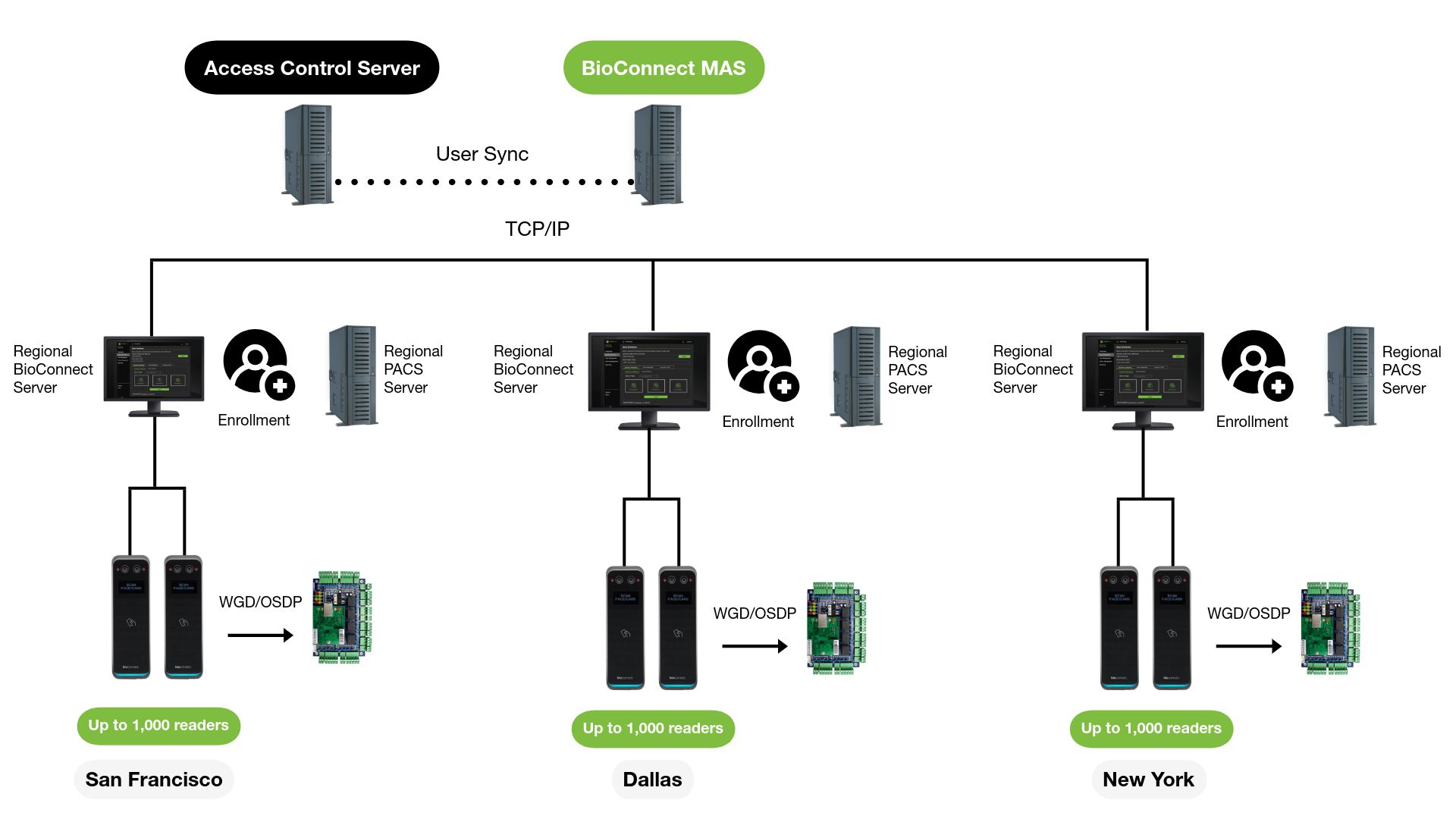
Here’s a data center access control example to put it in context.
- A data center operator has thousands of biometric readers installed at entrances, cages, data halls, and server rooms across sites located in several countries.
- An incident response specialist who was originally enrolled at the California site needs to travel to Frankfurt, Germany to help resolve a serious equipment failure.
- While he’s on the plane, an administrator uses the central system to grant him access to the required data center access points in Frankfurt. Since his identity, credentials, and biometric template are synchronized with the Frankfurt site, he doesn’t need to re-enroll, log a help ticket, or wait for local security to set up his access.
- The biometric readers installed in Frankfurt are ready to securely authenticate his face and key card as soon as he arrives.
Build Consent Into Your Enrollment Process
Biometric enrollment creates responsibilities that don’t exist with a key card or PIN. Organizations typically must obtain consent before creating a biometric template, keep a record of that consent, retain the template only as long as permitted, and delete it when the individual leaves or asks for its removal.
Any solution you’re considering should make it easy for you to track and enforce consent and generate audit-ready reporting. You need to be able to manage requirements under regulations such as GDPR, BIPA, and CCPA without relying on administrators at each location to update records separately.
Scale Biometric Security Without the Enrollment Slog
Traditional biometric enrollment can create real operational bottlenecks, particularly when hundreds or thousands of people must be enrolled across multiple locations. But the workload depends heavily on how the system captures, manages, and distributes biometric identities. With the right approach, enrollment can shift from a series of site-level tasks into a centrally managed process that easily scales with your enterprise.
Find the right biometric access control solution for your environment.
FAQs
Q: What is biometric enrollment?
A: Biometric enrollment is the process of registering a person’s biological characteristics, such as facial features or fingerprints. The system captures biometric data, converts it into a mathematical template, and associates that template with the person’s identity and access permissions.
Q: Do users need to be present for biometric enrollment?
A: Traditional fingerprint and facial enrollment usually requires employees to be present so the biometric enrollment system can capture their unique characteristics. However, some systems, like BioConnect, can create templates from approved profile images already stored in the organization’s PACS or HR system. This removes the need for a separate physical enrollment session.
Q: Do users need to re-enroll at every location?
A: It depends on the solution. With BioConnect Enterprise, once a user is enrolled, multi-site data replication ensures they can automatically authenticate at every reader, across every space they are authorized to access.